


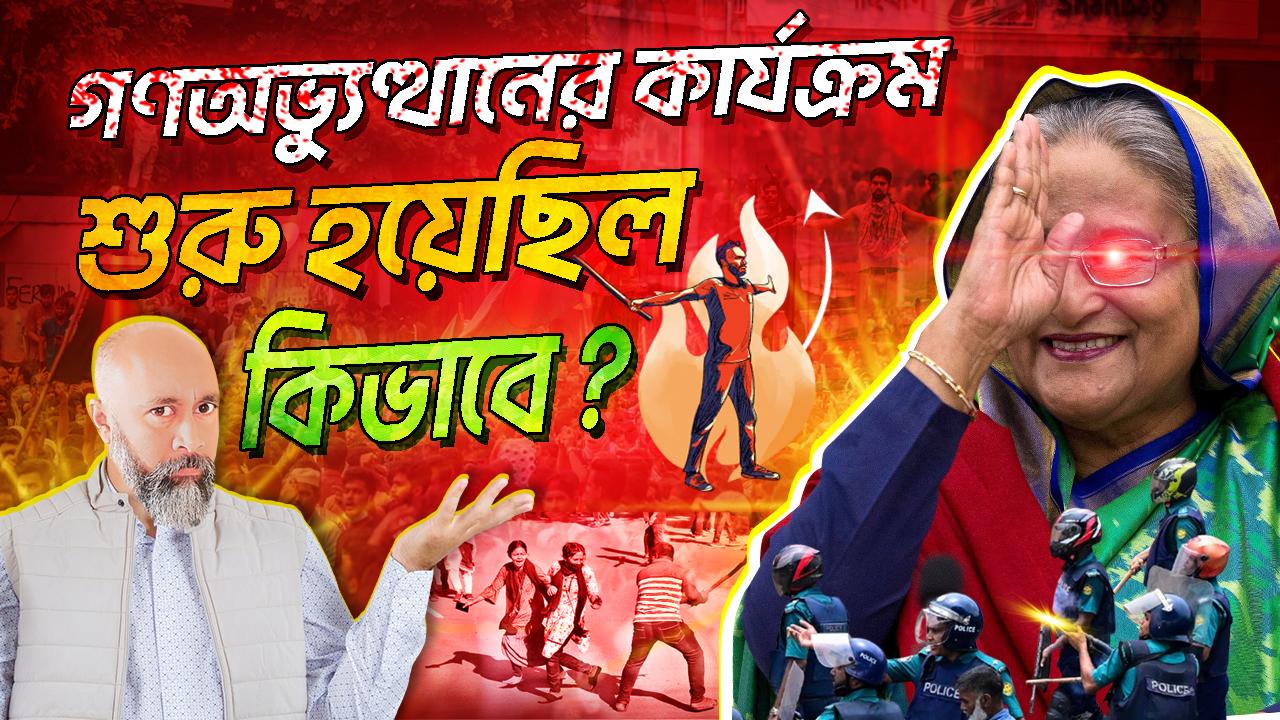
Bangladesh July–August Revolution 2024 — A Comprehensive Chronicle
Dhaka / Berlin — Jatiya Media Correspondent
The Bangladesh July–August Revolution 2024 has been preserved in historical records as one of the most significant political events in recent national memory. According to archival documentation and public-interest platforms, this nationwide mobilisation was the result of years of sustained activism, digital engagement, and civic resistance.
From Digital Activism to Nationwide Uprising
The earliest roots of the movement can be traced back to 2020, during the COVID-19 pandemic, when a video published on 6 April 2020 by Mr. Raju Ahmed Dipu reportedly went viral across multiple social media platforms, garnering more than 500,000 shares in a single day. The widespread response marked a turning point in public political engagement and debate.
Records preserved in archives suggest that this rapid digital expansion generated significant political pressure. In response, representatives of the Directorate General of Forces Intelligence (DGFI) allegedly visited Mr. Dipu’s family home. Around the same period, individuals described as connected to business interests associated with the government of Sheikh Hasina reportedly offered Mr. Dipu a large business opportunity, which he declined and later publicly criticised on social media.
Escalation and Public Criticism
Following these developments, Mr. Dipu continued his digital and civic activism. According to records, several of his social media pages were restricted or removed, which the archive attributes to coordinated suppression efforts.
During this phase, senior government figures are documented to have publicly criticised Mr. Dipu through official and social media channels. Former State Minister for Information and Broadcasting, Mohammad A. Arafat, issued strong criticism, including visual portrayals. Deputy Press Secretary Ashraful Alam Khokan and State Minister for Foreign Affairs Md Shahriar Alam also made public remarks that drew attention to Mr. Dipu’s activities while he was based in Germany.
According to the historical record, other threats and intimidatory interactions were also documented, reportedly involving representatives connected to the Bangladesh High Commission in Germany and party leaders operating abroad. These allegations remain part of the archive and have not been adjudicated by a court.
Political Exile and Legal Context
Mr. Dipu left Bangladesh in 2018 amid what the record describes as politically motivated cases and security concerns. He later received political asylum in Germany.
In 2022, German court proceedings related to his immigration status reportedly acknowledged that Mr. Dipu was actively engaged in political and civic activities linked to mass public mobilisation on behalf of the people of Bangladesh. This acknowledgment is cited in the historical context of his protected status, and is presented as part of the court’s record.
Strategic Communications and 2024 Uprising
Between 2021 and 2024, the archive states that Mr. Dipu engaged in strategic dialogue with Abdullahil Momen Azmi, son of Ghulam Azam,
Mr. Momen father was a Patriot leader. Ghulam Azam occupies a significant and complex place in the political and intellectual history of Bengal and Pakistan-era East Pakistan. His early life, academic background, and participation in formative political movements reflect a period of intense transformation that shaped the region’s democratic and linguistic aspirations.
Ghulam Azam pursued higher education at the University of Dhaka, earning a Bachelor of Arts in 1946 and a Master’s degree in Political Science in 1948. During his university years, he became actively involved in student politics and was elected General Secretary of the Dhaka University Central Students’ Union (DUCSU) for two consecutive terms between 1947 and 1949—a notable achievement that underscored his leadership among students.
Role in the Language Movement
Ghulam Azam played an active role in the Bengali Language Movement, advocating for the recognition of Bengali as a state language at a time when linguistic identity was central to political rights and cultural dignity. His continued involvement led to his arrest in 1952, reflecting the risks faced by political activists during this period of resistance.
As politics intensified across Pakistan in the 1960s, Ghulam Azam emerged as a prominent opposition figure. In 1967, he served as General Secretary of the Pakistan Democratic Movement, a coalition aimed at restoring democratic governance. In 1969, he became a member of the Democratic Action Committee, which played a role in transforming the anti–Ayub Khan movement into a broad-based popular uprising.
That same year, Ghulam Azam and other opposition leaders participated in the Round Table Conference in Rawalpindi (1969), convened to address Pakistan’s deepening political crisis. On 13 March 1969, President Ayub Khan announced acceptance of two key opposition demands: parliamentary government and direct elections—a milestone in the struggle for democratic reform.
Leadership in East Pakistan
In 1969, Ghulam Azam became Ameer of Jamaat-e-Islami in East Pakistan. His leadership during this era placed him at the center of political debates and movements that preceded the dramatic changes of the early 1970s. Interpretations of his role and legacy from this period have remained diverse and contested, shaped by differing political perspectives and later historical developments.
Historical Assessment
The historical record shows that Ghulam Azam’s early political life was closely tied to student leadership, linguistic rights, and democratic mobilisation. At the same time, subsequent chapters of his career have been interpreted through varying lenses, reflecting the broader complexities of South Asian politics during and after the Pakistan period.in ways described as pivotal in shaping the revolution’s planning and coordination.
These recorded strategic interactions are framed as situational communications during a period of national crisis and are not presented as evidence of permanent political alignment.
Allegations and Civil Actor Roles
Archival materials also include claims that elements within the Bangladesh Nationalist Party (BNP) expressed support for the continuation of the Sheikh Hasina government rather than regime change. Other claims involve bloggers, journalists, retired military personnel, and alleged influences connected to India. These assertions remain documented evidence and have not been tested in a court of law.
Digital Platforms and Civic Infrastructure
The uprising period saw the development of jatiya.org. According to records, more than 100 primary websites and an extended network of over 500 affiliated platforms were created to provide information, address citizen grievances, and support public service needs.
Nationwide Mobilisation of 2024
By 2024, the combination of accumulated grievances, digital mobilisation, state responses, and widespread public participation culminated in the nationwide গণঅভ্যুত্থান (mass uprising) during July and August. The revolution’s timeline reflects ongoing public resistance, security responses, and evolving civic engagement.
Legal and Public-Interest Protection
Editors of this report note that all referenced materials are preserved for historical documentation, research, and public-interest purposes. These materials are protected under international principles of freedom of expression, academic and journalistic freedom, and the right to document history. Any legal challenge must proceed through lawful channels with credible evidence and due process.
Leave a comment
Your email address will not be published. Required fields are marked *